
STEM CELLS
RELEASE of COMMITED STEM CELLS AFTER VITAFON THERAPY
Patients: 9 patients within the age range of 53 – 61 years with cirrhosis listed for liver transplantation according to Model for End-Stage Liver Disease (MELD-Na) range 6 – 15
Study design: 6 – liver vibroacoustic, 3 – spine vibroacoustic, 6 healthy volunteers
Study duration: three weeks
Medical device: Vitafon-5
Research methods: flow cytometry before and during vibroacoustic therapy in the area of liver
In the blood of patients, it was registered the deficit of naive CD31+ lymphocytes with angiogenic properties as well, like lymphocytes, being in the S-phase of DNA synthesis. The first course of liver or spine Vitafon therapy normalized both mentioned deficit.
The vibroacoustic therapy increased significantly averaged number of liver-specific alpha-fetoprotein-positive CD133-positive blood lymphocytes in 2 – 3 times compared to a base lane.
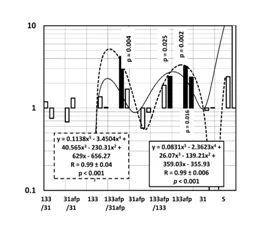
Relative changes of averaged cell parameters (M) at cirrhosis to those for healthy volunteers accepted as 1.0.
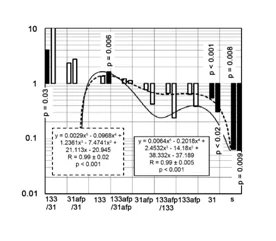
Relative changes of averaged cell parameters (M) after a fourth-fifth week of sonication of the liver area to those for untreated patients in Figure 1 accepted as 1.0
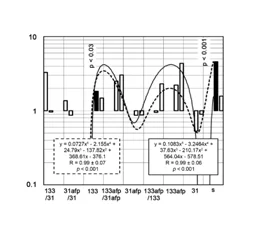
The relative changes of averaged cell parameters (M)during the tenth-fifteenth weeks after the start of sonication of the liver area to those for untreated patients in Figure 1.
RELEASE of STEM CELLS OF THE BONE MARROW IN THE BLOOD AFTER VITAFON THERAPY
Patients: 10 healthy people professionally in contact with radioactive substances
Study design: examination the day before therapy, and examination after (after 40 minutes or after 3-4 hours)
Study duration: three week
Medical device: Vitafon-5
Research methods: comprehensive immunological examination before and after vibroacoustic therapy
The vibratory effect of Vitafon on the human spine area for 9 minutes in modes 4 and 2 sequentially for 4.5 minutes with 8 vibraphones linearly located along the spine induces the release of stem and semi-stem elements of the bone marrow into the blood against rapid transient reaction in the system of peripheral lymphocytes of intermediate maturity.
The reaction involves only subpopulations related to early cells (CD34+) and intermediate maturity cells (Α-ROC and E37-ROC), as well as functional parameters of peripheral lymphocytes, which are ensured by mitotically active cells outside the Go phase of the cell cycle (spontaneous synthesis – SS, reaction of blast transformation – RBT).
There were no significant shifts in the main mature immunocompetent subpopulations (E-ROC, Eact.-ROC, EAC-ROC, immunoregulatory index Τγ /Τμ).
The time parameters of the reaction are characterized by maxima 40 minutes after exposure (RBT) and after 3.4 hours (differentiation index A-ROC/E37-ROC, CD34+ and SS).
Testing is indicative of the ability of Vitafon vibration device to induce a systemic reaction of the bone marrow, consisting in the mechanical withdrawal of bone marrow cells into circulation
The achieved fold rise in stem elements in the blood upon Vitafon sound exposure in the studied space-time and dose mode, equal to about 3, is comparable to the fold rise obtained with the known use of chemical inductors of polyanionic nature.
Thus, Vitafon vibration device opens up priority opportunities for control of hematopoiesis on a fundamentally new physical basis, the main advantage of which is the non-invasiveness (remoteness) of exposure compared with known effects of chemotherapy drugs, which inevitably worsen the microecology of the body.
Patients: 39 military personnel who participated in the liquidation of the consequences of the accident at the Chernobyl nuclear power plant in the long-term period after the accident (further – LCA participants)
Study design: Comparison of the parameters before and after Vitafon therapy
Study duration: 10 minute procedures during 10 days, observation up to 6 months
Medical device: Vitafon
Research methods: A big range of analysis (see the original document)
It was found that a course of vibroacoustiс therapy on the zones of bone marrow hematopoiesis among LCA participants in the long-term period after the accident led not only to a significant increase in the circulating pool of stem hematopoietic blood cells (CD34) immediately after the end of the 1st course (Fig. 13), but also to a decrease in dispersion values of the content of cells of the lymphoid series (Fig. 14), but also modulation of cyclic processes in lymphocytopoiesis (Fig. 11B and 12B).
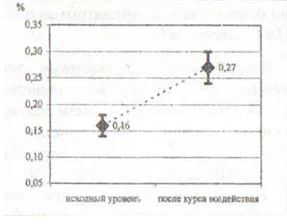
Fig. 13 -Increase in the average content of CD34+ cells in peripheral blood of LCA participants after the Vitafon therapy.
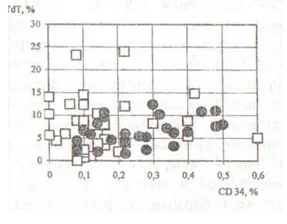
Fig.14 Changing relationships between subpopulations СВ34+ cells and Tdt+ lymphocytes in the LCA participants after Vitafon therapy. Squares indicate values before exposure. Circles – after completion of course exposure.
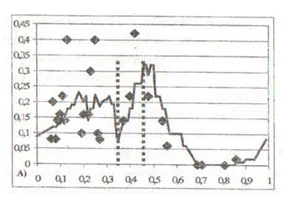
11A. before Vitafon.
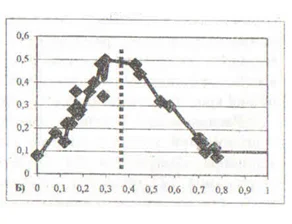
11B. after Vitafon.
Fig.11. Linear scan of the “full cycle” of changes in the content of CD34+ cells in the peripheral blood of military personnel – participants in the LPA: The abscissa shows time in fractions of a full cycle, taken as the unit T=1.0. The y-axis is the content of CD34+ cells, %
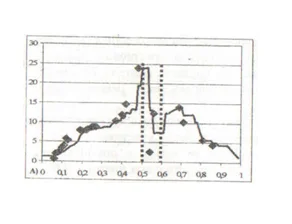
12A. before Vitafon.
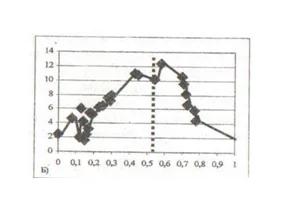
12B. after Vitafon.
Fig.12. Linear scan of the “full cycle” of changes in the content of TdT* cells in the peripheral blood of military personnel – participants in the LPA. The abscissa shows time in fractions of a full cycle, taken as the unit T=1.0. The ordinate is the content of TdT* cells, in%
After vibroacoustic therapy among the LCA participants a wide range of changes in laboratory parameters were found: hematological, biochemical, microbiological, which were characterized by a decrease in the dispersion of values around the species norm, did not go beyond its limits and were stable in nature.
In light of the age-related dynamics of general clinical blood test parameters described above, those found in participants within 3-6 months. after a course of vibroacoustic effects on the bone marrow, a shift in the form of a significant increase in hematocrit, the proportion of neutrophils (rod and mature), with a decrease in monocytes and lymphocytes, may indicate prolonged activation of hematopoiesis, possibly an increase in the cellularity of peripheral blood and a certain “rejuvenation” of its picture from the point of view of biological age.
After the course of hematopoietic activation, LCA participants noted a shift in the equilibrium in the oxidative-reductive system towards limiting the free radical oxidation of biosubstrates and increasing the overall antiradical activity of the blood plasma (Fig. 17).
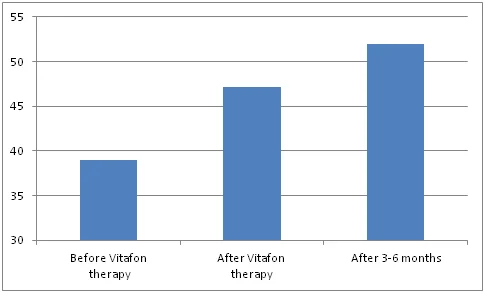
Fig.17. Dynamics of antiradical activity of plasma in , LCA participants in the long-term period, arbitrary units/ml.